
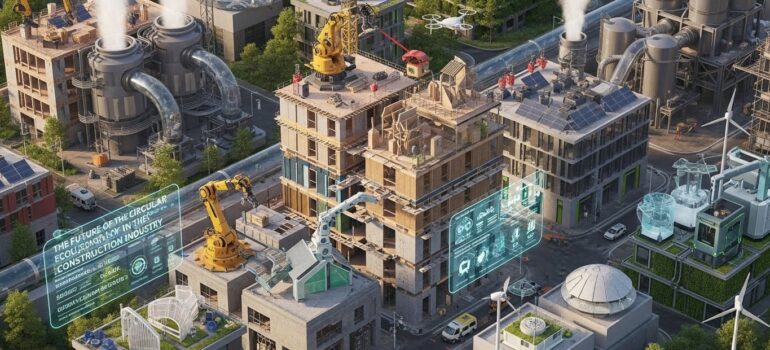
For over a century, the construction industry has operated on a linear model: extraction, production, installation, and finally, disposal. We dig materials out of the ground, turn them into buildings, and fifty years later, we bury them in a landfill. This “take-make-waste” system is reaching its physical and economic limits.
As we look toward 2025 and beyond, a radical shift is underway. The industry is bending the line into a circle. The Circular Economy is not just an environmental buzzword; it is a new economic engine that treats buildings not as static disposable objects, but as “material banks” for the future.
Why the Linear Model is Failing
The pressure to change is coming from three directions: scarcity, regulation, and cost.
- Resource Scarcity: We are running low on easy-to-access virgin materials. Sand suitable for concrete is becoming scarce in many regions.
- Supply Chain Volatility: The global disruptions of the 2020s taught developers that relying on global supply chains for new materials is risky.
- Waste Costs: Landfill tipping fees are skyrocketing as space diminishes.
In a linear economy, value is destroyed at the end of a building’s life. In a circular economy, value is retained.
The Concept of “Urban Mining”
The cities of today contain the mines of tomorrow. “Urban mining” is the process of reclaiming raw materials from existing infrastructure. Instead of blasting a mountain for copper ore, we harvest copper piping from a demolition site.
This shifts the role of the deconstruction industry from “waste management” to “supply chain management.” A company that takes down a building is no longer a garbage collector; they are a supplier of raw materials.
Trends to Watch in 2025
As this transition accelerates, several key trends are emerging that developers and contractors must track:
1. Digital Material Passports
Imagine if every beam, window, and door in a building had a digital ID. This is the concept of a Material Passport. Using Building Information Modeling (BIM), architects are documenting the exact specifications of materials installed in new buildings.
- The Goal: When the building is renovated in 30 years, the owners will know exactly what the materials are, how they were installed, and how they can be removed and resold.
2. Design for Disassembly (DfD)
Architects are beginning to design buildings with the specific intent that they will one day be taken apart. This means using screws instead of glues, and mechanical fasteners instead of chemical bonds.
- The Result: Future deconstruction will be faster, cheaper, and yield higher-quality salvage.
3. Product-as-a-Service (PaaS)
Some manufacturers are moving away from selling products to leasing them. In the future, you might not buy the lighting fixtures for your office building; you might lease the light from Philips. When the lease ends, the manufacturer takes the fixtures back to refurbish or recycle them. This incentivizes manufacturers to build durable, repairable products.
The Economic Case for Circularity
This isn’t just about saving the planet; it’s about supply chain resilience. By tapping into the build reuse industry data, developers can find local sources of high-quality materials that are immune to global shipping delays.
Furthermore, the tax incentives—specifically the IRS Section 170 deduction for donated materials—provide the immediate capital needed to grease the wheels of this economy. By donating salvaged materials to non-profits, property owners can unlock liquidity that traditional demolition destroys.
Barriers to Adoption
The transition isn’t without challenges.
- Certification: We need better standards for grading used lumber and steel so engineers can trust them in structural applications.
- Logistics: We need physical infrastructure—warehouses and processing centers—to store materials between the time they are removed from one site and needed at another.
- Labor: Deconstruction requires a skilled workforce. We need to invest in training programs to teach the art of unbuilding.
Closing the Loop
The circular economy creates a symbiotic relationship between development and community. When materials are salvaged, they often go to organizations that build affordable housing. The “waste” from a luxury teardown becomes the framing for a family’s first home. This social impact is a core pillar of partners who advocate for sustainable development.
Conclusion
The construction industry is the largest consumer of raw materials in the world. Shifting it to a circular model is a monumental task, but it is inevitable. The developers who adopt these practices early—who treat their buildings as renewable resources—will find themselves with lower costs, better ESG ratings, and a more resilient business model.To understand the global scale of this movement, the Ellen MacArthur Foundation offers the definitive roadmap for circularity in the built environment.


