
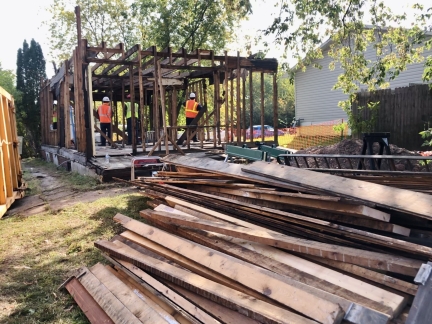
Construction and demolition (C&D) waste is one of the heaviest contributors to the global waste stream. Every time a building is mechanically demolished, thousands of tons of concrete, wood, drywall, and metal are mixed into a chaotic pile and shipped off to a landfill. This linear “take-make-waste” model is becoming increasingly unsustainable, both for our limited landfill space and for the planet’s ecological health.
Deconstruction offers a necessary pivot. By unmaking a building rather than destroying it, we shift the paradigm from waste disposal to resource recovery. The environmental benefits of this approach extend far beyond simply keeping trash out of a dump; they touch on carbon reduction, soil health, and the preservation of virgin resources.
The Landfill Crisis: Space and Toxicity
The most immediate benefit of deconstruction is landfill diversion. The EPA estimates that C&D debris generates more than twice the amount of generated municipal solid waste in the United States. When we demolish a building, we are filling finite holes in the ground with materials that often take centuries to decompose.
However, the problem isn’t just volume; it is chemistry. When organic building materials like treated wood or drywall break down in the anaerobic environment of a landfill, they produce methane—a greenhouse gas significantly more potent than carbon dioxide. Additionally, older buildings often contain materials that, while safe in a structure, can leach chemicals into the soil when crushed and buried.
Deconstruction allows for the surgical removal of hazardous items and the diversion of organic mass, mitigating these toxic byproducts.
Conservation of Virgin Resources
Every salvaged beam of wood means one less tree needs to be cut down. Every reclaimed window means less silica needs to be mined and melted. Deconstruction is arguably the purest form of recycling because it focuses on reuse rather than reprocessing.
Recycling usually requires energy to melt down and reform a material (like melting plastic bottles into new plastic). Reuse, however, keeps the material in its original form. A 2×4 stud salvaged from a 1970s home requires zero manufacturing energy to be used as a 2×4 stud in a new project.
- Lumber: Reducing demand for new logging.
- Metals: Lowering the energy-intensive burden of mining ore.
- Masonry: crushing concrete for aggregate reduces gravel mining.
For a deeper dive into the specific metrics of waste reduction, you can explore the environmental benefits of deconstruction vs demolition, which highlights the stark contrast in ecological outcomes.
Embodied Energy and Carbon
The construction industry is focusing heavily on “operational carbon”—how much energy a building uses when the lights are on. But “embodied carbon”—the energy used to extract, manufacture, and transport building materials—is just as critical.
When we demolish a building, we essentially “delete” all the energy that went into creating it. We then spend more energy extracting new materials to build the replacement. Deconstruction preserves that embodied energy. By keeping materials in the supply chain, we lower the overall carbon footprint of the new development.
The “Zero Waste” Construction Site
Municipalities are increasingly adopting “Zero Waste” goals. Achieving these targets is mathematically impossible with traditional demolition. A demolition project might achieve a 20% recycling rate if the concrete is crushed. A deconstruction project, however, can often achieve diversion rates of 85% to 90%.
Implementing a commercial deconstruction waste management plan is often the only way for large-scale developers to meet strict new green building codes and LEED certification requirements.
What Materials Avoid the Landfill?
It is surprising what gets thrown away during a standard demolition. In a deconstruction project, the following items are routinely saved:
- Dimensional Lumber: Framing studs, joists, and rafters.
- Architectural Features: Mantels, moldings, and staircases.
- Flooring: Hardwood strips that can be refinished.
- Fixtures: Sinks, tubs, and lighting.
- Masonry: Bricks that can be cleaned and re-laid.
The Role of Non-Profits in the Cycle
The environmental cycle is completed when these materials are donated. Organizations that accept these donations don’t just store them; they put them back into the community. This creates a circular economy where “waste” from a luxury development becomes affordable improvement materials for low-income housing. This social-environmental link is a key component of how nonprofits benefit from salvaged building materials.
Conclusion
Choosing deconstruction over landfill disposal is a decision that respects the limitations of our planet. It recognizes that materials have a lifecycle that shouldn’t end just because a building’s design is outdated. While the tax benefits and economic incentives often drive the initial decision, the long-term legacy of deconstruction is a cleaner environment and a more responsible construction industry.
For a broader perspective on waste management strategies, the EPA’s Sustainable Management of Construction and Demolition Materials offers excellent data and guidelines.


