
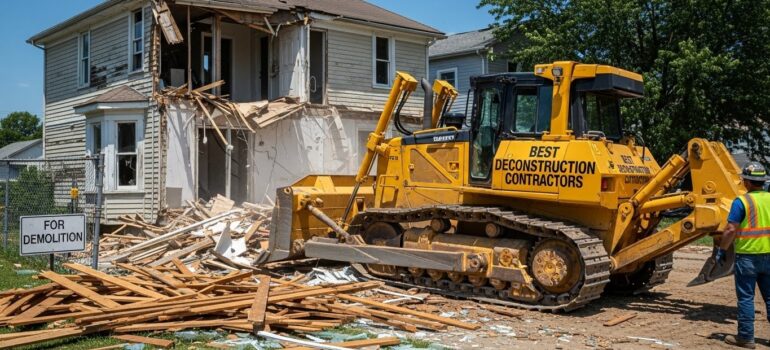
Deciding to tear down a home is a major financial and emotional decision. Once you have decided to deconstruct rather than demolish, the next hurdle is finding the right crew. Unlike standard demolition, which is a commodity service (who can smash it cheapest?), deconstruction is a skilled trade.
The “best” contractor isn’t the cheapest one; it’s the one that maximizes your salvage recovery while keeping your project on schedule. Here is what separates the top-tier pros from the amateurs.
1. Salvage Yield vs. Speed
A bad deconstruction contractor is just a slow demolition contractor. The best contractors understand that their job is harvesting.
- Look for: Contractors who can explain their “unbuilding” methodology. Do they hand-dismantle the roof rafters? Do they have a plan for denailing flooring on-site?
- Metric: Ask for their average “diversion rate.” The best residential contractors consistently achieve 85% to 95% diversion from the landfill.
2. Experience with “Surprises”
Residential teardowns are notorious for hiding secrets: asbestos behind the plaster, lead paint on the trim, or rot in the foundation.
- The Pro Approach: The best contractors have in-house or partner relationships for hazard abatement. They don’t shut down the job for weeks when they find a suspicious pipe; they have a protocol to handle it safely and keep moving.
- Safety: Ensure they are fully insured for deconstruction specifically, not just general construction.
3. The IRS Paperwork Trail
This is the critical differentiator. If you are banking on a tax deduction, the contractor plays a vital role in the chain of custody.
- Requirement: The contractor must be willing to cooperate with your independent appraiser. They must bundle, list, and transport materials in a way that allows the non-profit to verify the inventory.
- Red Flag: If a contractor says, “We just drop it off at the donation center and leave,” avoid them. You need a “warm handoff” to ensure the donation receipt is accurate.
4. Neighborhood Relations
Deconstruction takes longer than demolition (2 weeks vs. 3 days). This means your crew will be in the neighborhood longer.
- The “Good Neighbor” Policy: The best contractors maintain a clean site daily. They manage dust and noise to prevent your future neighbors from hating you before you even break ground on the new house.
Top Tier Recommendations
While local availability varies, look for firms that are members of the Building Materials Reuse Association (BMRA). Companies like Deconstruction Development Partners specialize in high-value residential projects, ensuring that the gap between the teardown and the new real estate development is seamless.
Conclusion
Your deconstruction contractor is the first partner in your new home build. Their performance determines your tax savings and your environmental footprint. Choose a team that treats your old home with as much care as you will treat your new one.


