
In the world of commercial real estate, data is king. You don’t just build a building; you document it. The same rigor is now being applied to the removal of buildings. Whether driven by municipal mandates or LEED certification goals, a Commercial Deconstruction Waste Management Plan (WMP) is now a standard requirement for major projects.
A WMP is not just a form you file to get a permit; it is a strategic roadmap for how materials will flow off your site. A well-executed plan can lower disposal costs, generate tax benefits, and boost your company’s ESG (Environmental, Social, and Governance) score.
Component 1: The Pre-Project Audit
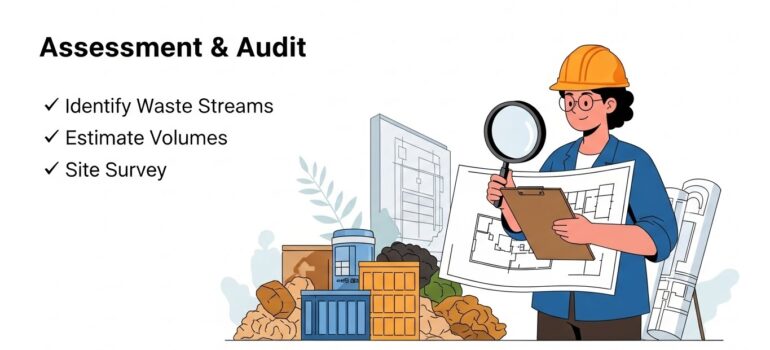
You cannot manage what you don’t measure. The first step of any robust commercial building deconstruction service is the waste audit.
- Identification: A team walks the building to identify waste streams. How many tons of steel? How many square feet of acoustic ceiling tiles? Is the concrete clean or contaminated?
- Forecasting: The plan estimates the total weight of the project and sets a diversion goal (e.g., “We will divert 85% of total material weight from the landfill”).
Component 2: Source Separation vs. Commingled
This is the most critical operational decision in the plan.
- Source Separation: Crews separate materials on-site into different dumpsters (one for wood, one for metal, one for concrete). This yields the highest recycling rates and the highest revenue for scrap, but requires more site space.
- Commingled (Single Stream): All debris goes into one bin and is sorted at a facility. This is faster and takes less space, but often results in lower recycling rates due to contamination (e.g., drywall dust ruining recyclable paper or cardboard).
For projects seeking maximum value, source separation is preferred. It allows for the harvesting of specific assets for donation, which is the backbone of the Deconstruction 4-to-1 Donation Benefit Program.
Component 3: Vendor Selection
Your plan must list exactly where each material is going. “To the dump” is no longer an acceptable answer for many cities.
- Concrete: To a crushing facility to become aggregate.
- Metal: To a scrap metal recycler.
- Salvage: To a non-profit reuse center.
- Trash: To a licensed landfill.
You must verify that these vendors can provide weight tickets. Without a weight ticket, you have no proof of diversion.
Component 4: Tracking and Reporting
The plan is a living document. Throughout the project, the site manager must track every load that leaves the site. This data is aggregated into a final report.
- LEED Credits: For LEED certification (specifically MR Credit: Construction and Demolition Waste Management), you need precise calculations. The WMP provides the evidence required by the US Green Building Council.
- Municipal Compliance: Many cities require a final “Waste Diversion Report” before they will sign off on the Certificate of Occupancy for the new building.
The Role of Consultants
Creating a compliant WMP is complex. It involves knowing local tipping fees, recycling facility capabilities, and tax laws. This is why developers often hire specialized consultants to draft and oversee the plan. Utilizing delta institute deconstruction market assessment data can help benchmark your plan against industry standards.
Conclusion
A Commercial Deconstruction Waste Management Plan transforms waste from a liability into a metric of success. It proves that your development is responsible, sustainable, and compliant. In an era where investors are scrutinizing the environmental impact of their portfolios, a strong WMP is a competitive advantage.For guidelines on creating these plans, the Whole Building Design Guide offers templates and best practices for construction waste management.